
Your Guide to Choosing a Golf Sim Projector
Sim Weekly by Yardstick Golf

Good Morning, Golfer!!
Here’s what we’ve got for you this week: finding the right projector, hitting mats under $900, and a peek inside Tommy Fleetwood’s TGL bag.
Let’s tee it up! ⬇️
🔥 Scroll for your internet golf find of the week
👀 The Three-Putt: 3 Golf Picks You Can't Miss
📰 Must-Read: Uber Golf is here. Here’s what it means for you and your golf crew.
⛳ Must-Try: Only have a balcony to your name? Bet—turn it into a golf simulator.
👀 Must-See: The Shotscope LM 1 is still in pre-order, but you can see it in action here.
🔨 Picking a Projector
Of all the decisions in this build, choosing the projector ended up being the most involved.
I already knew the specs that matter for golf simulators—brightness, throw ratio, resolution, and longevity—but actually finding one that worked perfectly for my garage layout took some extra digging.
Here’s what actually mattered when choosing mine.
Brightness
Garages aren’t dark rooms.
Even with the door closed, light leaks in. If you want a picture that doesn’t wash out, brightness matters.
My rule of thumb:
Minimum: 3,000 lumens
Ideal: 4,000+ lumens
That extra brightness makes a big difference on an impact screen.
Throw Ratio
This one can make or break your setup.
Throw ratio determines how big the image will be based on the projector’s distance from the screen. My projector was going to be ceiling mounted about 12 feet away, so I needed something that would fill the screen perfectly at that distance.
To be safe, I ran my measurements by Carl’s Place support when I shared my layout—and they helped point me to the right models.
Resolution
For most simulators, 1080p is the sweet spot. It delivers sharp visuals and clear shot data without the big price jump to 4K.
Laser vs Lamp
Lamp projectors require bulb replacements every few thousand hours.
Laser projectors last ~20,000 hours with consistent brightness and no maintenance. More expensive upfront, but much easier long term.
The Projector I Chose
After narrowing things down, I landed on the BenQ LU710.
It checked every box for my setup:
4,000 lumens (bright enough for daytime use)
Perfect throw ratio for my 12-foot mount
Laser light source with ~20,000 hour lifespan
Native 1080p resolution
At around $1,800, it wasn’t the cheapest option—but the projector is the one thing you look at every time you use the sim. Getting that piece right felt worth the investment.
Golf projector calculations aren’t for the week…that’s why we made this calculator to make it easy. Enter a few data points and get the information you need to have confidence in your golf simulator design plans!
🔥 Sim Steals and Golf Deals
Top Deals:


Launch Monitors:
Garmin Approach R10 | Now $399.99 (was $599.99)
Rapsodo MLM2PRO Golf Launch Monitor & Simulator | Now $699.99
Full Swing KIT Golf Launch Monitor & Simulator | Now $3,999 (was $4,999)
Garmin Approach R50 Golf Simulator & Launch Monitor | Now $4,499.99 (was $4,999.99)
SkyTrak+ Golf Launch Monitor & Simulator | Now $1,795 (was $2,495)
Golf Mats & Turf:
Big Moss High Impact Golf Mat | Now $349 (was $379)
SIGPRO Turf Golf Mat | Now $599 (was $699)
Landing Pad Mat for SIG10 Golf Simulator Enclosure | Now $899.99 (was $999.99)
Cimarron 4’ x 6’ Ultimate Golf Mat | Now $299.99 (was $339.99)
Projectors & Accessories:
Panasonic PT-VZ580U Golf Simulator Projector | Now $1,399.99 (was $1,999.99)
BenQ TK700STi Golf Simulator Projector | Now $1,599 (was $1,699)
Optoma GT2000HDR Short Throw HD Laser Projector | Now $1,199 (was $1,499)
BenQ LH600ST+ Short Throw Golf Simulator Projector | Now $1,499 (was $1,599)
BenQ AH700ST Golf Simulator Projector | Now $2,299 (was $2,499)
Golf Gear:
Back 9 Botanicals PERFORMANCE CANNA+ GUMMIES | Now $53.99 (was $65.97)
Ben Hogan GS53 Fairway Woods | Now $119.99 (was $169.99)
Retractable Golf Swing Training Aid | Now $23.99 (was $39.99)
Arccos Link | Now $67.68
🏌️ Under $900: Bullseye vs. Gung Ho
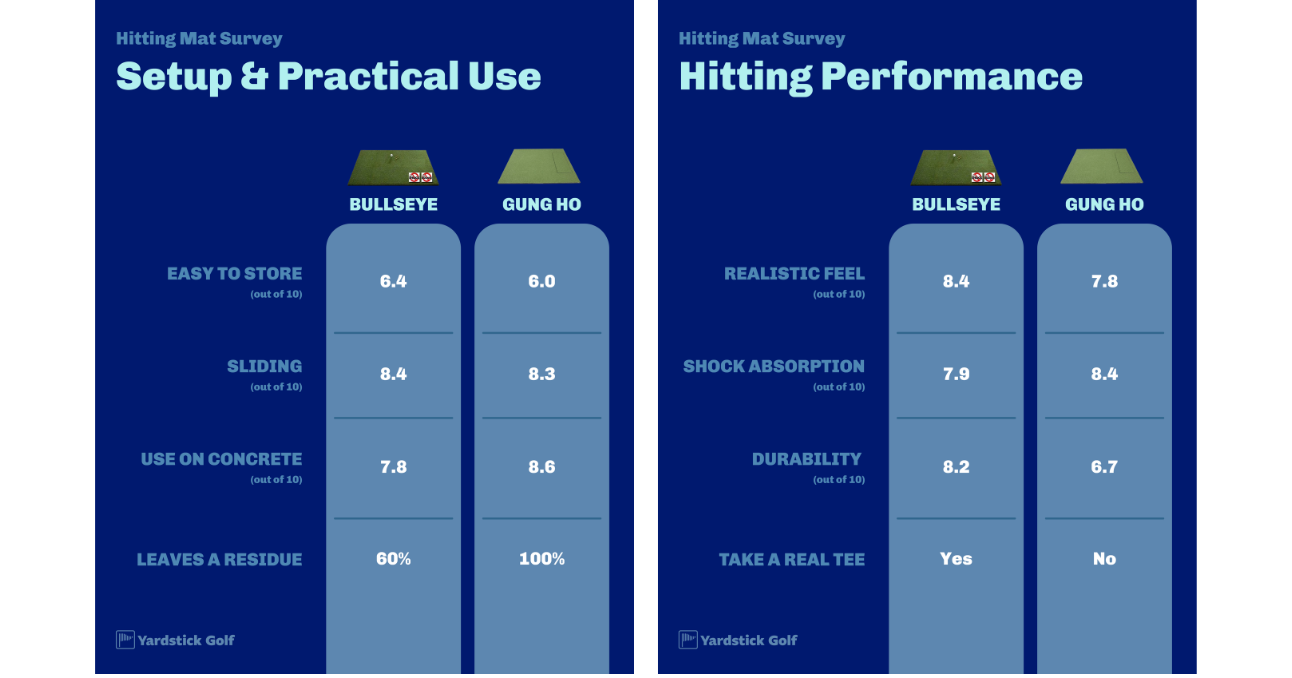
Not every simulator build needs a $1,000+ hitting mat. In fact, some of the most popular garage setups use mats in the $400–$900 range, where you can still get solid realism and durability without blowing up your budget.
Two options that come up again and again in this price tier are Bullseye Golf and the Gung Ho Holy Grail. Both are designed to replicate real turf interaction while protecting your joints during long practice sessions.
So how do they stack up?
Hitting Performance
When it comes to the actual hitting experience, Bullseye pulled ahead.
Survey respondents rated Bullseye higher for realistic feel (8.4) and durability (8.2)—two factors that directly affect how well the mat simulates real turf and how long it will hold up to repeated swings.
One big differentiator: Bullseye allows you to use real tees, which many golfers prefer for driver practice and a more natural setup. The mat’s design is meant to replicate fairway turf while still letting the club move through the surface without grabbing.
Gung Ho still performed well here—especially in shock absorption (8.4). Its layered foam design is specifically built to reduce stress on wrists and elbows while still providing feedback when you hit the ball fat.
Setup & Practical Use
Once you move beyond the swing itself, the two mats are surprisingly close.
Both performed well when used on garage floors and concrete, which is where most home simulators live.
Gung Ho had a slight edge in use on concrete (8.6 vs. 7.8) and was nearly identical in sliding stability, meaning both mats tend to stay put during swings.
Where Bullseye stood out again was versatility—particularly because of its real-tee compatibility and stronger durability scores, which make it easier to integrate into many DIY simulator builds.
The Verdict
Bullseye wins the under-$900 showdown, delivering better feel, stronger durability, and real-tee compatibility—making it the stronger all-around hitting mat in this price range.
Gung Ho still earns points as a comfortable, shock-absorbing option for golfers who want extra joint protection and solid stability on concrete.
Next up: the best hitting mats under $600!
⛳ WITB: TGL Winner Tommy Fleetwood
He’s the #3 player in the world and one of the most recent TGL champions. If you’re copying anyone’s bag, make it his. We partnered with Next Round to see how close you can get — on a budget.
Use code GGEAR10 to get 10% off site wide.
Driver: TaylorMade Qi4D LS Driver
Only one Qi4D is listed, but plenty of older Qi models are available — you can get close.
Mini Driver: TaylorMade R7 Quad Mini Driver
One is on the site right now — mint condition, $100 off. Snag it before it’s gone.
Fairway Woods: TaylorMade Qi35 Fairway Woods, TaylorMade Qi10 Fairway Wood
Qi35 and Qi10 fairways are widely available. A Qi10 starts at just $135 — one of the best value plays in this whole setup.
Irons: TaylorMade P7TW Irons
The P7TW can be tough to track down, but a full set from an older model runs $334.99.
Wedges: TaylorMade Milled Grind Wedges
Next Round has ‘em in great condition for under $100. Easy win.
Putter: TaylorMade Spider Tour Black
You may not find Fleetwood’s exact model, but Spider putters are a Next Round staple — and one of the easiest upgrades you can make.
TLDR: You can get pretty darn close. A Tommy Fleetwood bag won’t make you the #3 golfer in the world, but it’s a solid start.
Level: Impossible
Thats it for today, golfers! Tune in next week for our final thoughts on the build.
Want to work with us?
Get your brand in front of 6.5K engaged sim golfers with Sim Weekly. Learn more here.
Disclaimer: we may make a small commission when you purchase off of our links. Thank you for supporting Sim Weekly!